Why Agency and Client Numbers Never Match: Time Zones, Dates, Currencies and Duplicates
Meta shows more leads than the CRM, days shift and sales land in another month. Where reporting gaps come from and how to agree on counting rules with a client.
See it in 20 seconds
Short recordings of the panel with an example organisation, no sound.
On this page
- Why do the agency's report and the client's report show different numbers?
- How does the ad account's time zone change daily results?
- Lead date or sale date: which one should you count?
- Why does Meta show more leads than the CRM?
- How do you total results from accounts in two currencies?
- How do you agree on reporting rules with a client?
- How does Convs handle this?
- Limitations: what can't be fully reconciled?
- Where should you start?
- Sources
The agency sends its report: 212 leads in October. The client replies that the CRM shows 187 and that "something is off". Screenshots go back and forth, and a week later nobody remembers what the question was. Most of the time both sides are right; they are just counting different things. This article takes the usual gaps apart and shows how to write rules that stop the report from being an argument.
Why do the agency's report and the client's report show different numbers?
Because they count differently, not wrongly. Ads Manager counts days in the ad account's time zone and credits results according to the ad set's attribution setting. The CRM counts people in its own time zone, sales on the day they close, and only leads that actually arrived. Every one of these differences can be explained.
Here are the common causes and how to reconcile each one.
| Cause | What happens | How to reconcile |
|---|---|---|
| Time zone | What happensThe ad account and the CRM start the day at different hours | How to reconcileRecord each source's zone; compare weeks or months, not single days |
| Lead date vs sale date | What happensA sale from an October lead lands in November | How to reconcileJudge campaigns by a lead-date cohort; book sales by closing date |
| Attribution | What happensMeta credits results using the ad set's setting | How to reconcileCompare only ad sets that use the same attribution model |
| Leads that never arrived | What happensThe integration missed some submissions, or 90 days passed | How to reconcileCompare Meta's lead count with the CRM count per ad |
| Duplicates | What happensOne person submitted two forms | How to reconcileDecide whether a "lead" is a submission or a person |
| Currencies | What happensTwo ad accounts in different currencies | How to reconcileDon't add them up; one row per currency |
How does the ad account's time zone change daily results?
Meta reports ad data in the ad account's time zone. When the account is set to a different zone than the one the client's CRM works in, day boundaries drift apart. Totals over a long period barely move, but single days and the last day of the month do.
An example (example data): the ad account is set to UTC and the business works in New York. On October 31, 2026, New York is still on daylight saving time, four hours behind UTC.
| Event | Time in New York | Day in the CRM | Time in the account's zone (UTC) | Day in Meta's report |
|---|---|---|---|---|
| Lead form submitted | Time in New YorkOctober 31, 9:30 pm | Day in the CRMOctober 31 | Time in the account's zone (UTC)November 1, 1:30 am | Day in Meta's reportNovember 1 |
| Spend in the same hour | Time in New YorkOctober 31, 9:30 pm | Day in the CRM— | Time in the account's zone (UTC)November 1, 1:30 am | Day in Meta's reportNovember 1 |
The same lead belongs to October in the CRM and to November in Meta. With a few hundred leads a month that is a handful, but in an "October vs November" review it is enough to make someone ask where they went. Write down each source's time zone and compare whole weeks or months. Changing an ad account's time zone is a decision to make once and deliberately, not in the middle of a reporting dispute.
Lead date or sale date: which one should you count?
To judge campaigns, count a cohort by lead date: everyone acquired in the period and how things ended for them. October spend then sits next to sales from October leads, even when contracts were signed in November. Accounting counts sales by closing date, and it is right too.
The trouble starts when the agency counts one way, the client the other, and nobody says so. The agency's October report keeps "growing" for weeks as sales from month-old leads come in. The client's report shows November revenue that October spend paid for. Both are honest as long as they are labelled.
A good habit: show the client a lead-date cohort and say clearly that the most recent weeks are still open. Why cost per qualified lead and cost per sale are counted this way is explained in our article on cost per qualified lead.
Why does Meta show more leads than the CRM?
Usually for three reasons: Meta counts results under its own reporting rules, some submissions never reached the CRM, and the CRM merges repeat submissions from the same person. Each cause is checked differently, so compare the counts per ad or per form rather than only as an account total.
Attribution and reporting time
The attribution model and settings are chosen at ad set level, and they decide which conversions Meta credits to your ads. Meta itself says results from ad sets with different attribution models should not be compared in one table. On top of that, the Insights API documentation says on-Meta actions (such as link clicks) are reported by impression time, while off-Meta actions (such as website purchases) are reported by conversion time. A CRM has none of this, so numbers near the edges of a period can differ.
Leads that never arrived
The Results column in Ads Manager counts every submission in the selected period, but leads can only be downloaded for 90 days after the form was submitted. If an integration stopped for two weeks and someone noticed four months later, those leads are gone. Shorter gaps can usually be filled with an import. How leads reach a CRM and how to check that the integration works is covered in our article on Meta lead ads to CRM.
Duplicates: a submission or a person?
The same person can fill in a form twice, or two different forms. Meta counts two leads. A good CRM merges them into one record by phone or e-mail. Both numbers are correct, but they describe different things: submissions or people. For sales the rule is simpler: one person and one deal is one sale, however many forms they sent. Meta applies the same idea to events, as our article on event deduplication explains.
How do you total results from accounts in two currencies?
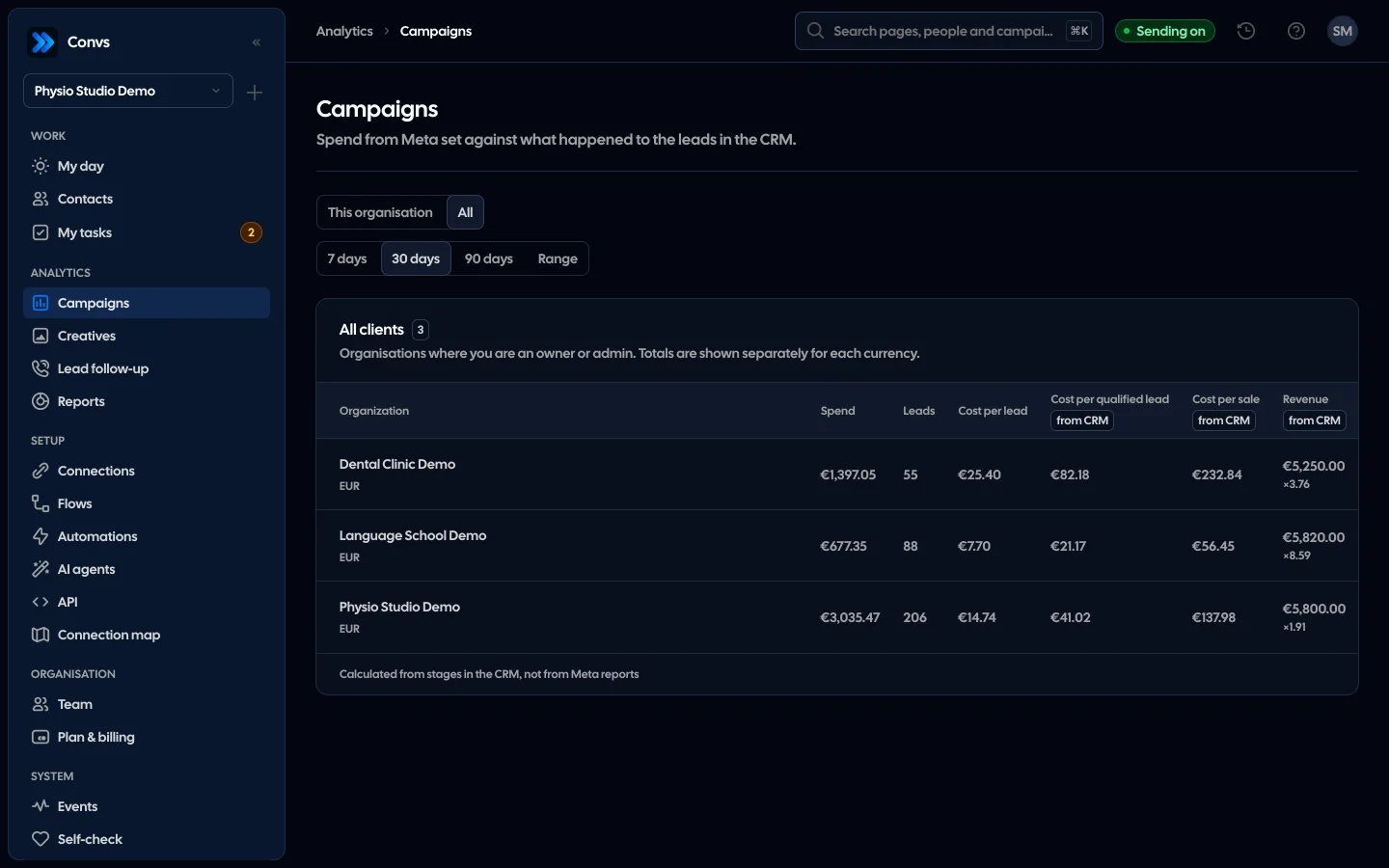
You don't. Spend in pounds and spend in euros are two numbers, and converting at the rate on report day gives a different result depending on who calculated it and when. Show one row or one set of tiles per currency, and calculate costs and return on spend only within the same currency.
If the client insists on a single figure, agree on a rate in writing (for example, the monthly average from one named source) and label the result as a conversion. Revenue in one currency divided by spend in another produces a number that looks serious and means nothing.
How do you agree on reporting rules with a client?
On one page, before the first report rather than after the first dispute. The rules should say what every column means, which source it comes from, which time zone defines a day and which date a sale is booked to. A gap then becomes a question about data instead of a question about who made the mistake.
The minimum list:
- Source of each number. Spend and impressions from Meta; leads, qualification and sales from the CRM.
- Time zones. The ad account's zone and the CRM's zone, written down.
- Booking date. Campaigns judged by a lead-date cohort; sales in the finance report by closing date.
- What a lead is. A submission or a person. Which CRM stage counts as "qualified" and which as "sold".
- Currencies. No totals across currencies; any conversion uses a named rate.
- Organic leads. Their own row, with no cost.
- Who updates stages, and how fast. If CRM stages are updated once a month, the last few weeks of any report are always incomplete.
More on how an agency can structure access to client data and roles is in our article on Meta ads reporting for agencies.
How does Convs handle this?
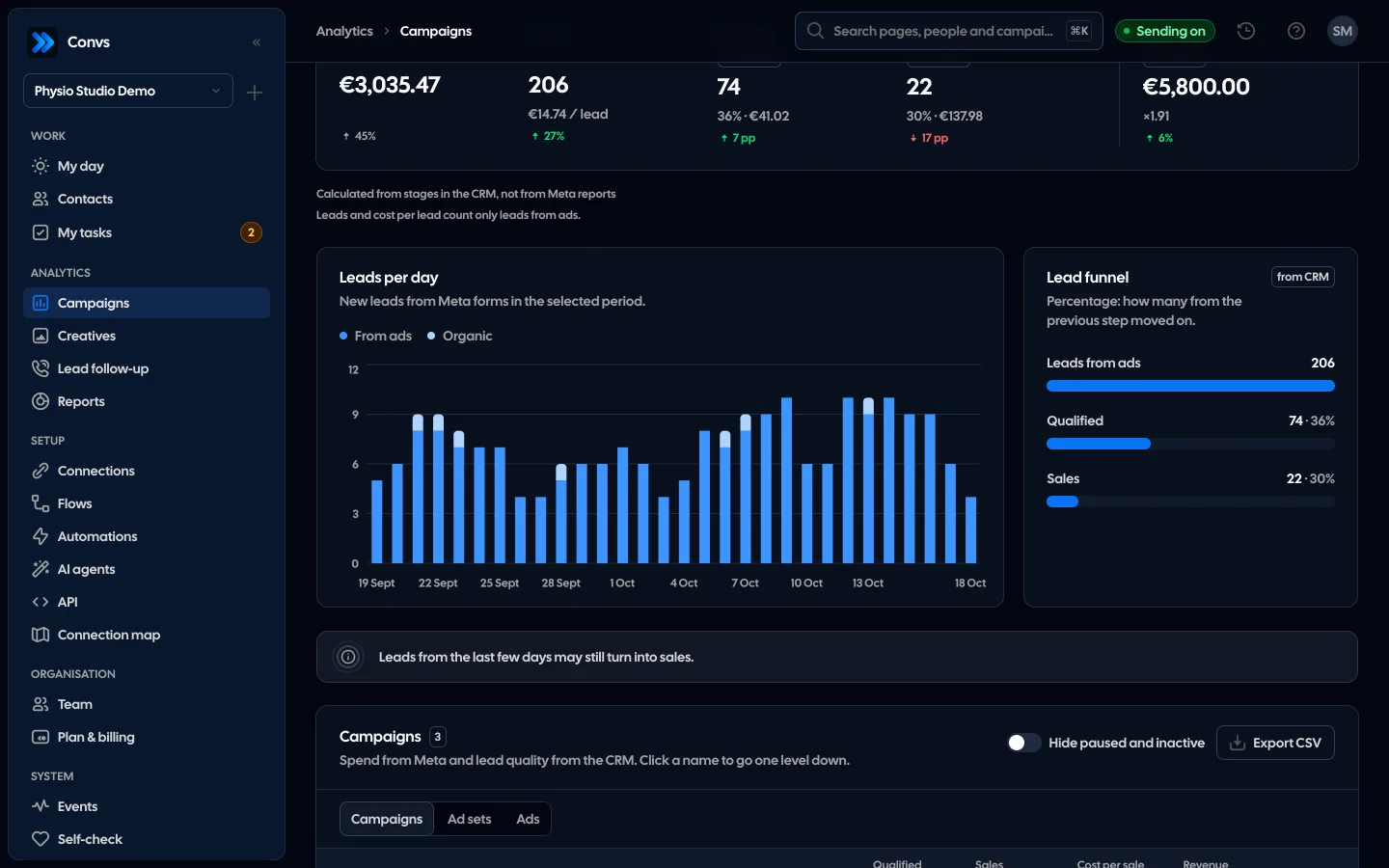
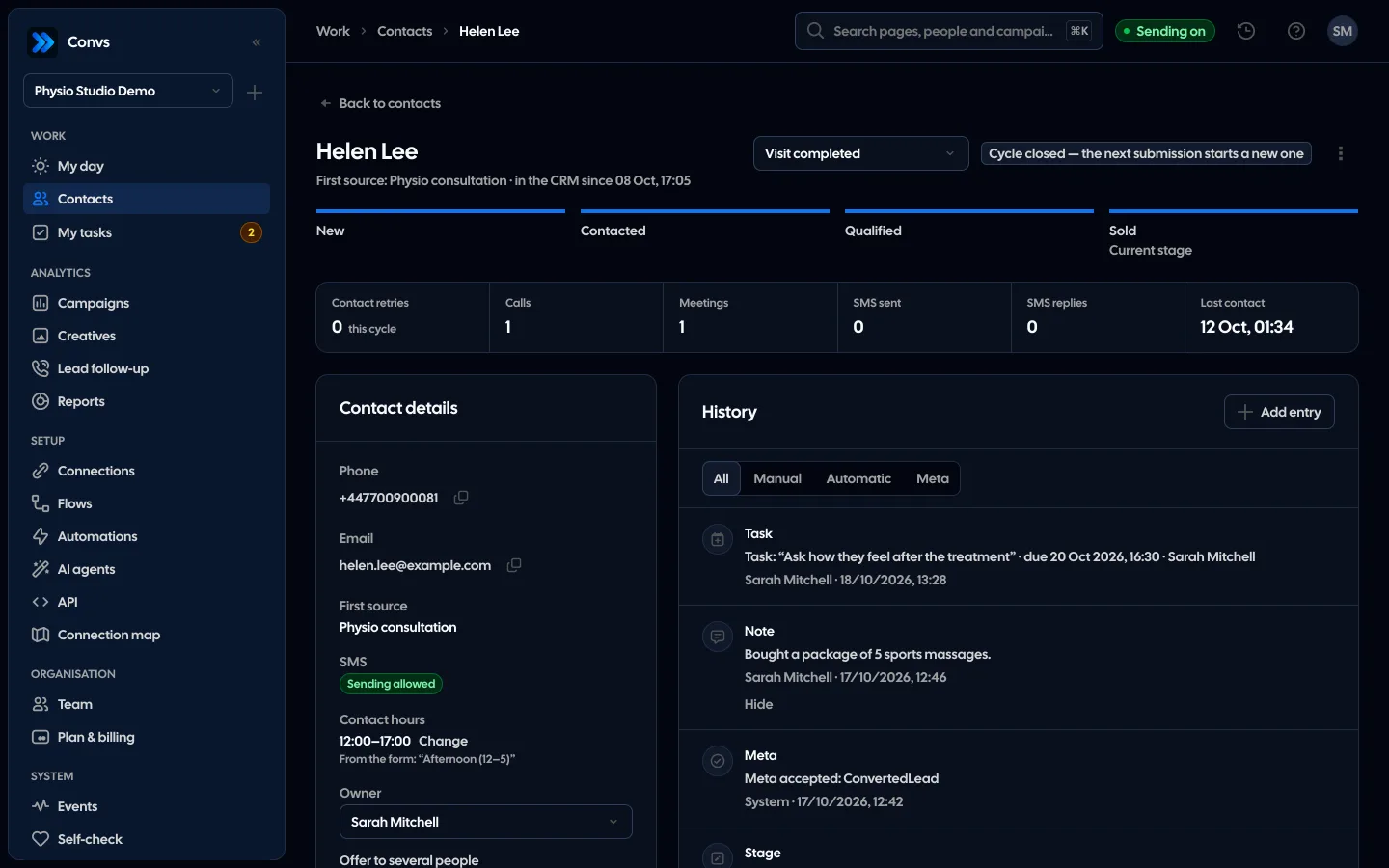
Convs joins Meta spend with stages from its CRM and applies several of these rules by default. The period in the Campaigns report is the lead date (a cohort). Spend days are counted in the ad account's time zone and leads in the organisation's. Qualified means the Qualified or Sold stage, and a sale counts once per person and cycle. Every ad-account currency gets its own set of tiles and nothing is converted; revenue against spend is shown only within one currency. Organic leads have their own row with no cost.
The table shows Meta's lead count next to the leads in Convs. When Meta counts more, the row warns that some leads did not arrive and offers to fetch the missing ones with a 90-day import. Users who are owner or administrator in at least two organisations also get the all-clients overview: one row per client, with totals per currency. Details on the agencies and campaign reporting pages.
Limitations: what can't be fully reconciled?
Some gaps can be described but not removed. Meta's attribution and a CRM cohort answer different questions and will not produce the same number. Leads older than 90 days that the integration missed are lost to the CRM. A cohort for the latest weeks keeps changing while the sales team updates stages.
A CRM report is also only as good as the team's discipline with stages. If the client marks sales once a quarter, no reporting rule fixes that. And one more thing: sending CRM stages to Meta gives Meta data, but it is not proof that a campaign optimises on that data or that a sale was attributed to an ad.
Where should you start?
Take last month and compare Meta's lead count with the CRM count for each ad. Where the gap is large, check the integration and duplicates first and attribution second. Then write down the seven rules above with your client and attach them to every report.
Sources
- Meta for Developers: Insights API, Limits & Best Practices (data in the ad account's time zone; reporting time for on-Meta and off-Meta actions)
- Meta Business Help: About attribution models and attribution settings (attribution set at ad set level; don't compare ad sets with different models)
- Meta Business Help: About expired leads (leads downloadable for 90 days; the Results column counts every submission)
About the author
Aleksander
Founder of Convs.io, BooksyAudit.pl and SMSPortal.app
Founded Convs.io, BooksyAudit.pl and SMSPortal.app. In the knowledge base he explains how to send leads, CRM stages and sales back to Meta and how to measure what a customer from ads costs.
All articles by the authorFrequently asked questions
Which numbers are the real ones: Ads Manager or the CRM?
Both, because they answer different questions. Ads Manager tells you how many results Meta credited to your ads under its attribution setting. The CRM tells you how many people reached the business and what happened to them. For reporting, pick one source per metric and write it down.
Does the attribution setting change the number of leads Meta reports?
The attribution setting decides which conversions Meta credits to your ads, and you choose it at ad set level. Meta warns against comparing ad sets with different attribution models in the same table. A CRM has no attribution window: it counts every lead that actually reached it.
How should we count a customer who filled in two forms?
Meta counts two leads, because there were two submissions. In a sales report, count the person: two forms and one deal are one sale. Your rules should say plainly whether the leads column means submissions or people, and that a sale counts once per person.
What if the client books a sale in a different month than the agency?
Usually one side counts the sale by its closing date and the other by the lead date. For judging campaigns, a cohort by lead date is better, because it puts spend next to the people that spend brought in. Accounting needs the closing date. Show the two views separately.
Why do daily results shift by one day?
Meta reports in the ad account's time zone. If the account uses a different zone than the client's CRM, a form sent just after midnight local time can land on the previous day in Meta's report. It affects the edges of days and months, not the overall total.